Sunday, March 26, 2017

#44 - Arnott's Tim Tam (chewy caramel)

If one were to view my collection of player's club cards (or whatever they're called) from the various casinos I've been to, one might come to the conclusion that I have a bit of a gambling problem. As usual, one would be mistaken. I do not gamble (with good reason: I once converted $10 of free play into a whopping $0.79 in winnings), but there is a perfectly logical reason for me to own said cards: I enjoy a good buffet (that makes more sense, now, doesn't it?), and casinos tend to have good buffets, complete with discounts for card-carrying members.

My lack of interest in gambling extends to horse races (in my younger days, I did dabble in it via my Commodore 64, which I'm sure is just as exciting as the real thing), so one might bet (if one has a gambling problem) that I could never in a million years guess the name of the horse that won the Kentucky Derby in 1958.

Yet again, one would be wrong (why does one even try?), and, yet again, there is a perfectly logical explanation (again involving my appetite): in 1958, Ross Arnott was a spectator at the "Most Exciting Two Minutes In Sports" (i.e., the Kentucky Derby, if you haven't figured that out) and decided to "borrow" (i.e., steal) the name of the winning horse for a newly designed cookie (which itself was inspired by Penguin biscuits).

Thus, Arnott's Tim Tam was born, a product that has through the years seen its fair share of variations, and today (wouldn't you know it?) I am tasked with reviewing the chewy caramel edition:

A cookie by any other name would taste as sweet.

In my humble opinion, this might just be the worst name origin I've come across (though it's hard to beat the Violet Crumble, which is another Australian creation; maybe Aussies just have trouble coming up with names). The product has nothing at all to do with horses (I hope), and the name (which is itself of uncertain origin) gives no indication as to what a Tim Tam is (if I were to guess, I'd suspect it referred to a Scotsman named Tim who really loved his cap). Perhaps Mr. Ross Arnott thought naming the cookie after the winning horse would bring the product success (which would hint at a superstitious nature; though Tim Tam never won the Triple Crown, so let's not set our sights so low), or perhaps he won a large chunk of change on the race (say, more than $0.79) and wanted to honor the horse responsible (which would hint at a possible gambling problem). Regardless, there is no good reason to name one's confections so haphazardly (even if today the name has become synonymous with the cookie rather than the horse).

Name aside, the packaging is really well done; it is clear Arnott's (or Pepperidge Farm; though Arnott's is an Australian company, Tim Tam has been distributed in the USA via Pepperidge Farm since 2008, and my package is decidedly American) has a world-class art team at their disposal. The swirling chocolate and caramel artwork as well as the breaking cookie graphic are exquisite, and the overall layout works. It definitely gives off a mass-market vibe, which is not necessarily a bad thing; really, the package design is every bit as successful as Tim Tam himself (I refer here to the horse, not my imaginary Scotsman friend). If I were pressed to point out flaws, I would suggest that the font for the name (though it might just be the name) seems slightly out of place, as does the parrot in the Arnott's logo (but that couldn't really be helped, could it?).

So a fine job thus far.

Well, they got it right to two decimal places...
The "best before" date can be found on the side of the package, and it happened to be Pi Day! Unfortunately, that means I missed the date (only by one day, actually, since, as usual, this review comes some time after my first tasting). To make matters worse, I didn't even eat any pie that day (oh, the tragedy of it all!). But my package of Tim Tam was given to me in an airtight bag, in which I had total confidence, so spoilage should not be an issue.

The top of the back of the package contains a brief retelling of Ross Arnott's "inspirational" day at the races. I'm not sure whether Arnott's is proud of their "creativity" or they're simply trying to explain to the consumer why their cookies have such a nonsensical name, but it takes up a significant portion of the back side, so they must've felt it was important one way or another.

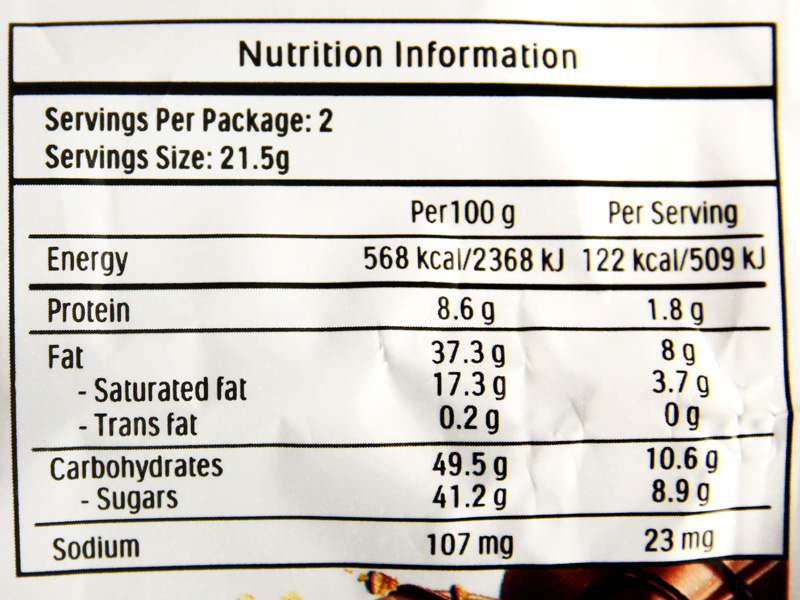
At the bottom (partially obscured by the flap) is the nutrition facts panel (which also wraps around the edge some; if space were such an issue, maybe they should've cut short their origin story):

It's too much trouble to count the cookies, okay?

A quick scan of the data reveals that the Tim Tam has considerably more fat and sugar per gram than Tunnock's Real Milk Chocolate Caramel Wafer Biscuits, which I reviewed recently. I find that interesting, as both promise a chocolate-covered caramel cookie experience, and I loved Tunnock's offering; could Tim Tam's extra fat and sugar lead to a superior product? I suppose anything is possible, but forgive me if I'm a little skeptical.

Another item of note is that, while a serving is two cookies, the servings per container is a vague "About 4." So there are "about" eight cookies enclosed. I wouldn't think it would be so hard to verify whether or not a package holds more or less than (or exactly) eight cookies.

I guess we shall see.

To the side of the nutrition facts one can find the ingredients list:

How many times can you find the word "milk" in this list? (Answer: About 4)

Again, I can't help but compare the ingredients to those of Tunnock's caramel wafer biscuits, contrasting the similarities with the differences. For instance, caramel gets top billing in the Tunnock creation, while only making third place in Tim Tam. Based purely on the ingredients lists, I would bet (if I were a gambling man, that is) on Tunnock's wafer biscuit in a head-to-head battle. I also have a hunch that Tim Tam may be the cheaper of the two products to produce; however, it is a hunch with no merit whatsoever, so you might as well ignore it.

Okay, then. With the perfunctory outside investigation completed, it was time to tear into my package of Tim Tam and taste for myself the "irresistible chocolaty happiness in a cookie™."

Pictured: About 2 servings.
My initial impression was quite favorable; the aroma wafting from within was (as anticipated) not exactly luxurious, but it was sweet and appetizing (I felt I could really smell both the chocolate and caramel), which goes a long way.

The cookies come in a handy tray, neatly arranged so that one can count how many one has (it turns out "About 4" servings means nine cookies; I guess "4.5" was a bit too much for them to calculate), or (if one is a pessimist), how many one has already eaten.

I actually had expected more, as the spacing between cookies is greater than I'd imagined, but I suppose it should keep their appearance from being compromised in transit; I've already seen enough heartbreaking examples of candy mishaps to last a lifetime, so I am thankful to see Arnott's treating their own with such care.

Retrieving one of the cookies from the protective tray, I discovered their efforts were not in vain.

Say, that looks familiar...
My sample looked surprisingly like the illustration on the front of the package. It was surprising because too often the artist's rendition (even when a photograph) is an idealized fantasy of the actual product the consumer receives. It is refreshing to see a treat that bears a convincing resemblance to the example picture, so once again I take my hat off to Arnott's (figuratively speaking, of course; I am not wearing a hat at the moment).

But it doesn't matter if a sweet is the most beautiful thing I've ever seen (Tim Tam isn't, by the way, but it at least looks as it should) if its taste leaves me in despair.

So how does Arnott's Tim Tam fare in the real test?

Exceptionally well, I'm pleased to say! The chocolate, cookie, and caramel are brilliantly proportioned, and the distinct textures play together like a well-oiled orchestra (I think I've mixed up my simile there)! Frankly, I have nothing negative to say about it; it satisfied my taste buds with flying colors.

Therefore, Arnott's Tim Tam (chewy caramel) earns a top spot in my rating scale with a well-deserved 4 (or should I say "About 4"?). If I had to choose, I would give the edge to Tunnock's caramel wafer biscuits (as my Sweets Fiend Senses™ predicted), but make no mistake: Tim Tam is a true winner (and here I refer to both the horse and cookie)!

So if you have not yet had the pleasure of indulging in Tim Tam's chewy caramel adaptation, take a gamble and buy yourself a package.

Trust me, the odds are in your favor.

Fearing I've discovered a new addiction,
The Sweets Fiend

Chocolate-covered caramel-filled cookie? You can't lose!

Sunday, March 12, 2017

#43 - Choward’s Guava Candy

There is a certain plot one often finds in video games and movies (or seamless mixes of claymation, toys, miniatures, rubber suits, and cartoons), wherein some malignant force which has been dormant for any number of years awakens (or reveals itself) to wreak havoc on the world. Inevitably, it is up to a small band of heroes to wage war (in an epic fashion) against the evil presence.

If you are at all a fan of the action, fantasy, and/or science fiction genre(s), you have no doubt personally encountered such a story in one form or another. Sure, it has become something of a cliché, but it can still provide a base upon which a thrilling yarn may be spun (because if spinning yarn is not thrilling, I don't know what is).

Or at least I hope it can, because today's review is very much along those lines.

Way back when my wife first suggested I try my hand at a candy review blog, she selected a variety of candies from an international goods retailer to get me started. One of the items purchased was promptly deposited into my sweets stash and forgotten.

There it has remained for the last two years, quietly plotting who knows what while awaiting the day it would finally be rediscovered.

Today is that day.

And so I present to you: Choward's Guava Candy!

Your eyes deceive you.

Though the company is officially C. Howard Company, Inc. (named after one Charles Howard), they've chosen to go with "Choward's" for the branding, which I actually find less appealing, though I couldn't say why (because I don't know, not because it's a secret). It doesn't help that the packaging is not that attractive, either, despite being oddly photogenic (trust me, it loses something once it's in your hand). Whether it's the color scheme or guava graphics (or, more likely, a combination of the two), there is a unique quality to the packaging that saddens me and produces the desire to drop it back in my candy cache. It is a mysterious phenomenon, I assure you; it is not a particularly ghastly design, but it does not seem the work of a company that's been in the candy game since the 1930s.

Between the joyless packaging and the lengthy stay in my sugar storehouse, I felt it would be wise to acquire aid in my mission, so I called upon everyone's favorite crustacean-themed robot helper: TTR-CRAB 900 (I don't know if a pair of misfits constitutes "a small band of heroes," but TCR-FRESHY 5000 had a prior engagement and was unable to offer assistance)!

Being the people-pleasing go-getter that he is, TTR-CRAB 900 wasted no time in commencing his investigation, starting with the "best by" date:

"A Delicious Confection" they say. And I'm sure they aren't biased in the least.

As might be expected, I had missed the suggested date. By a month. Oops.

Still, I suspect that the greater the recommended shelf life, the less a day or two (or thirty) will matter. I mean, after twenty or so months, what's one more, right? So I wasn't too worried about it, and neither was TTR-CRAB 900 (he's pretty easygoing, as far as robot crabs go).

In addition to the "best by" date, the weight of the product, country of origin (USA!), and company website are provided. Not too shabby, although I don't need C. Howard Company, Inc. to tell me their candy is delicious. I can do that myself (well, with the help of TTR-CRAB 900). Besides, "delicious" is a generic word that doesn't tell one anything (which I suppose is why I use it so freely when reviewing better sweets).

I quickly grew bored of looking at this side of the package and asked TTR-CRAB 900 to continue the evaluation.

One quick turn and we discovered the ingredients list:

You want nutritional information? I hope you've got some free time...

The list starts off innocently enough (with sugars and the vague "natural and artificial flavors"), but soon switches to more sinister sounding items, like magnesium stearate and Red 40 Lake. TTR-CRAB assured me that, even though it's most commonly used in pharmaceuticals and is one of the two components of soap scum, magnesium stearate shouldn't kill me.

What a relief!

Perhaps even more foreboding is the absence of any nutritional information; C. Howard Company, Inc. has decided, in their infinite wisdom, that it would be just as convenient for one to write a letter and wait for a response than to try and read a tiny nutrition data panel. That is how I often work when contemplating the purchase of consumables anyway; I pick up the item in question, pen a thoughtful message to the manufacturer of said item, and sit back in anticipation while the U.S. postal service does its thing. What could be handier?

Fortunately, one can find the elusive info online if one wishes. But even that is not worth the effort, so I will save you the trouble by telling you now (SPOILER ALERT!): three pieces of Choward's Guava Candy contain five grams of sugar, and that's it. There is no other nutritional value whatsoever. I do not see why C. Howard Company, Inc. could not have put that somewhere on the package. Granted, it wouldn't be in the traditional nutritional information panel form, and it might be hinted at by the ingredients list, but why not spare a few precious moments of their customers' lives?

I'm just saying.

Anyhow, having just wasted a few precious moments of my reader(s) lives, it would probably be for the best to carry on with the review...

TTR-CRAB 900 carefully opened the package (there was some confusion involved, as both sides said "open here;" I hope we chose correctly!) and withdrew three pieces (the suggested serving size) of the guava candy:

Attack of the Super Crab! YOU WILL ALL BE DESTROYED!

I admit to being taken aback by the candy's appearance. I had been predicting the product to take a thicker, chewier form. I guess I need to be more aware of ingredient lists' implications; all the clues were there to indicate the hard, chalky consistency one finds in candy necklaces or Flintstone Vitamins (both of which contain magnesium stearate, by the way).

Each piece is finely embossed with the Choward's logo. I've got to hand it to C. Howard Company, Inc. here: the candy may give off a cheap vibe in substance, but the imprinting is expertly done; the logo is crisp and clear, which is rarely the case at this scale. It was, quite frankly, the first time Choward's Guava Candy impressed me.

Perhaps the taste would produce a similar effect?

Meh.

My first thought upon placing one in my mouth was that the guava flavoring bore a striking similarity to the mango portion of the dreaded Usher Chili Mango Twisted Bongos, which naturally did nothing to excite my taste buds. By the third sample, however, the comparison was forgotten, replaced by the sensation of gritty, crunchy sugar.

Don't get me wrong: I was (and am) still not especially fond of the guava taste, but I didn't mind it much, either. If you can imagine a piece from a candy necklace with the added flavor of guava, you'll have an excellent idea of what to expect from the product.

And so, I rate Choward's Guava Candy a bland 2. I was a bit apprehensive about this one, and it actually turned out better than I had supposed (it will sufficiently curb a sweets craving in an emergency), but I'm afraid that, for me, it will never achieve first-string status.

Does our story today have a happy ending? I'm not sure. It was anticlimactic, certainly. There were no real victories or defeats to speak of. It was nothing like the epic tale I had envisioned (and practically promised).

Even so, I'm currently taking a break from my usual nutritional information requests to concentrate (with the aid of TTR-CRAB 900, of course) my writing efforts on the screenplay.

Just in case.

Patiently lying in wait until my next appearance,
The Sweets Fiend

They're just like vitamins without the nutrition!

Sunday, February 26, 2017

#42 - Tunnock's Real Milk Chocolate Caramel Wafer Biscuits

Throughout history, it has been customary for a son to follow in his father's footsteps, career-wise. For instance, if one's father is king, one is probably going to end up king one day (unless one happens to be Charles, Prince of Wales). From plumbers to funeral directors to purveyors of junk (even British purveyors of junk), fathers are keen on passing on more than their genes to their offspring, and the words "and son" are ubiquitous in the business world.

Still, there are times when one's son feels called to forge his own path in life. Maybe he's just not that into ruling the galaxy or making toys, or maybe the father's job is literally as dull as watching paint dry. Whatever the reason, it affords the son the opportunity to alter the course of his bloodline, with a new livelihood to pass down for generations to come (or not; kids can be so rebellious, after all).

Such was the case when Thomas Tunnock opted not to carry on his father's coffin-building legacy ("Why live a miserable life when for 30 bob you can be buried comfortably?"), instead striving to make miserable lives a bit less so with the opening of his own bakery (he even used his dying wish to ensure his son would continue the dream; he wasn't taking any chances!).

I, for one, am thankful for the divergence; I am unlikely to need a coffin from Scotland in my lifetime (or death, for that matter), but I can always go for a sugary treat, and Tunnock's Real Milk Chocolate Caramel Wafer Biscuits sound like just the thing to satisfy that craving!

This reminds me of a circus or carnival, minus the excitement and terror.

First off, I think the name "Tunnock" sounds like it was pulled straight from a J.R.R. Tolkien novel, which isn't too unreasonable, as it's a Scottish name from days long gone (we're talking centuries here). Perhaps it is this sense of tradition and history that led to the anachronistic package design; it is equal parts old-fashioned and modern, showing true dedication to the company's heritage whilst paying homage to current trends. The top is adorned with the words "still original size," which is a heartening phrase if ever I've heard one; who among us has not at one time or another lamented the decrease in volume of his or her favorite treats? And the featured mascot/child (who was, in some tragic turn of events, left without a name) harks back to simpler times, before such dreadful realities as candy review blogs.

Really, it's all very well done, but, to be blunt, it doesn't do much for me. I can't fault Tunnock's, as I believe they have achieved success in all their package design goals. I honestly appreciate their sentiments, I just don't find myself craving what hides behind the shiny metallic wrapper. And despite his easy smile and polished appearance, I do not want to be Tunnock Boy's friend (I think I shall take it upon myself to name him "Shteve" (for some reason I suspect he has a speech impediment), not to be confused with "Phteven").

But it's a simple matter of opinion; I still commend Tunnock's artists and visionaries for their talents.

Space for rent?
Anyhow, the "best before" date can be found on the back of the package, in a much-larger-than-necessary blank canvas of sorts (the entire back of the package lacks the flair of the front; it's almost as if they forgot it was there until the minute before production was to commence). I don't know if Tunnock's lacks confidence in the precision of their date-printing machinery or they are leaving space for future use, but I suppose it doesn't matter; the date is easily readable within the otherwise bare expanse of whiteness.

My actual consumption of the candy preceded the publishing of this review by a shamefully long period of time, so I did beat the expiration date (by at least a tiny bit), so lay your worries to rest (seriously, you worry about the silliest things).

Typical values indeed.

The nutritional information panel shows that, gram for gram, the biscuits are very much comparable to an average candy bar in terms of nutrition (or lack thereof, if you prefer). As I'm a big fan of candy bars (and getting bigger with each one), I would like to think that this in some way bodes well for Tunnock's creation. I might be way off base, but I'd still like to think it; considering chocolate caramel wafer biscuits sound delightful to me anyhow, I believe there's plenty of room for optimism (just like there was plenty of room for the "best before" date).

Also included in the panel is the address of the Thomas Tunnock Limited headquarters (and website), which is not uncommon (I refer here to candy manufacturers providing their own addresses; it would be quite uncommon, and probably frowned upon, for other manufacturers to supply the Thomas Tunnock Limited address on their own candies).

So far, no real surprises, which is itself not very surprising, since the Tunnock's brand seems so deeply rooted in tradition; "traditional" and "surprising" are words seldom matched together.

The ingredients list is no different:

Suitable for vegetarians? And here I was expecting a pork filling...

Every ingredient listed is readily found in countless other candies and sweets. There is not a single entry to cause alarm or even interest (unless, of course, one has wheat, soy, and/or milk allergies). But caramel is (woo-hoo!) the first ingredient, so that's a plus.

Fortunately, a dull ingredients list need not translate into a dull product. Thomas Tunnock Limited has simply chosen to stick with tried and true components, and there's nothing at all wrong with that.

Or maybe there is. I guess I'd have to try one to know for sure, wouldn't I?

It's like the package gave birth... to twins!
And so I pulled one out of the package... and discovered they are individually wrapped! Personally, I found that to be a welcome feature, despite it adding an extra step between me and the milk chocolate caramel wafer biscuit. One thing I noticed, however, is that the wrappers were rather loose, suggesting that perhaps that the reason for their existence is something other than preservation.

The wrappers continue the motif of the outside package; in fact, it was at this point that I realized (I'm a tad slow) the package front contains a (slightly off-scale) cutaway graphic, displaying the six internal biscuits. I don't know how I missed that before (I was probably too distracted by Shteve's floating head), but it's a nice touch. Additionally, the individual wrappers contain the ingredients list (always a considerate move), as well as the claim: "MORE THAN 5,000,000 OF THESE BISCUITS MADE AND SOLD EVERY WEEK!" That's more than a quarter of a billion per year. Not bad for a product I had never heard of. Not bad at all.

This could really be any chocolate-covered wafer biscuit.
So I opened up one of the biscuits.

To be completely honest, my initial impression was not entirely favorable. The smell of the chocolate was not particularly encouraging, and the appearance (including the bottom), while perfectly acceptable, was nothing to write home about (maybe worth making note of in an amateur candy blog); although its shape is typical of such a product, I could not help but notice its likeness to a coffin. It's possible I was just struggling to find something unique about the treat; after all, what could lead to the demand for million and millions of the treats each year?

As it turned out, Tunnock's real milk chocolate caramel wafer biscuits did have a trick up its sleeve: it was absolutely delicious! It was crunchy. It was chewy. It was a masterful blend of chocolate and caramel. It was everything I could ask of Tunnock's and more!

I was in every conceivable way impressed, and it is without reservations that I rate Tunnock's real milk chocolate caramel wafer biscuits a 4! It is a product any company should be proud of, and though Thomas Tunnock did not live to see its inception, I am eternally grateful for his decision to pursue baking; my life is indeed less miserable because of it.

As a disclaimer, I should mention that those with whom I shared samples did not share my love for the candy (though all liked it to some extent; one suggested it might have been better at a greater distance from the expiration date, which is a fair point). But they are not writing this blog, so their opinions are of no importance. In fact, forget I said anything (I'm too lazy to delete it); instead, go seek out some of the delectable biscuits yourself. You won't regret it.

In case I have not yet expressed my feelings on the product with the utmost clarity, I leave you with a question: is there any chance I could be buried in a giant Tunnock's milk chocolate caramel wafer biscuit?

I'd be willing to pay upwards of 30 bob.

Happy to be alive,
The Sweets Fiend

Please, sir, I want some more!

Saturday, February 4, 2017

#41 - Nestlé Polo (original)

Polo (anglicised from the Balti word for "ball;" yes, we essentially call the game "ball") is a competitive team game played on horses. It originated in Persia more than two thousand years ago, but is still played today (and while perhaps not the world's most popular sport, it did inspire a well-known clothing line, so that's something). Water polo (no relation) is a competitive team game played in (what else) water, sans horses, dating back to the late nineteenth century (it is also still played). Marco Polo was a traveler of days gone by (1254-1324), whose name has (relatively recently) been borrowed by a water-based game of blind tag (which involves neither balls nor horses and has no relation to either of the aforementioned games, but, again, is still played).

My point is that there are a lot of things to associate with the word "polo," and each is as likely as any other to come to my mind upon hearing it. But if you're a British mint lover, the word could very well produce a hankering for the ring-shaped candy first manufactured in 1948 by a man named John Bargewell: the Polo mint (in this case, "polo" is allegedly derived from the word "polar," but I have my doubts)!

"Original?" Sorry, but I'm not sure there's anything original about you, Polo.

Now, it wasn't all that long ago that I, in no uncertain terms, declared my lack of fervor for mints. Yet, lo and behold, I find myself again confronted with a pack of the pitiable candies. A small part of me is hopeful, however, as Polo makes no claims about being "extra strong." On the other hand, the candy's slogan is "The Mint with the Hole," which is perhaps the worst slogan I've ever come across (even the Violet Crumble's slogan seems inspired by comparison). If your product's most notable feature is a hole, you might want to reexamine your priorities, especially if your product is not unique in regard to said "feature." Lest you think I'm being overly harsh in my criticism of Polo's obsession with holes, I present to you two bits of information that may sway your opinion in my favor:

Exhibit A: In 2004, Lord Justice Mummery (who arguably has one of the greatest combinations of title and name the world has ever known), dispensed both wit (rough as it might have been) and justice when he rejected Nestlé's appeal to trademark the Polo's unoriginal shape, claiming "This is an appeal with a hole in the middle."

Exhibit B: The slogan is not only lousy, it's also a total rip-off; Life Savers used it (complete with the candy taking the place of the "o") back in 1917, more than thirty years before Polo even existed.

So Polo is basically a knockoff trying desperately to convince the world otherwise. Which is why I question even the origin of the name.

Controversy aside, the packaging is well done; it is not the Lord Justice Mummery of designs, but I would definitely place it well above Trebor's attempt. The color palette and art style toe the line between playful and dignified (which I guess makes it more the Lord Justice Mummery of designs than I'd first thought). Sure, one could argue that it misses the mark on both fronts, but I think the artists at Nestlé ought to be proud of their work here; at least it's not a complete duplicate of its competitors (as far as I know).

This is ugly on so many levels.

Anyhow, the "best before" date on the package is vague (and rather sloppy, if I may say so; are they still using the original printer from 1948?), giving only a month instead of a particular day, which hints at the fact that expiration dates need not be taken too literally. Having had my fair share of "expired" treats, I can say firsthand that candy (especially hard candy) is usually good well beyond the suggested consumption period.

But, as I had tried my first Polo in January (I tend to run late with my reviews, if you hadn't noticed), it's a moot point, so I might as well move on.

Shall we?

How many mints would you like? Seven? Oh, okay.

The nutrition facts panel (which understandably wraps around the roll), reveals that Polo is mostly just sugars (nothing wrong with that, right?). It's not too surprising, really. In fact, its stats are very much in line with other mint products. It is unusual, though, in that I haven't often seen words like "nil" and "trace"in such a section.

"Trace" refers to stuff that's not intended to be in the candy but finds its way in anyhow (because the same equipment is used for multiple products, for instance). It's thoughtful of Nestlé to provide the information; it allows one to concoct any number of theories as to where, say, the protein comes from (I'm guessing insects, personally).

I am not sure why "7 sweets" was chosen as the reference, however. It seems like a lot of mints for any insignificant period of time (I don't know anyone who considers significant periods of time when planning their mint intake), and it can be an awkward number for mental division (fortunately, dividing the 42 by 7 to get 6 Calories per Polo is straightforward enough).

And then we have the ingredients list:

Children under four, please read this carefully!

There aren't many ingredients that go into a Polo (again, not surprising, as it's mostly sugar). The only item to catch my eye was "stearic acid," which, aside from providing some light reading via its Wikipedia page, is not too exciting. The warning about young children choking takes up the lion's share of the section, which is okay with me; if you're going to care more about something than what's in your candy, choking children is a respectable option.

The section ends with an inconspicuous instruction to store the product in a cool and dry place. That's generally good advice for sweets storage and at the present a thankfully simple directive to follow, it being winter here and all.

With the wrapper thoroughly investigated, it was time to unveil the candies in all their untrademarkable (why use real words when a fake one will do?) magnificence:

Wow! They are unlike anything I've ever seen!

Whereas Trebor peppermints are approximately the diameter of a quarter, Polo mints have chosen to emulate the penny (so not even its size is original, though, to be fair, it is between two to three times as thick). Maybe it's just a coincidence, but there seems to be some sort of correlation between the proportions of American coins and British mints. Is it some elaborate scheme to undermine U.S. currency (I might buy into that if the mints weren't worth more than the coins)? I don't know, but it does mean that coin wrappers should double as mint packages in a pinch, so be sure to keep some handy if you have a knack for destroying your British mint wrappers (life hack!).

Besides the "one-of-a-kind" hole, Polo mints are embossed with their name, which isn't at all like Life Saver candies. Not one bit. It's a completely different name and everything. They also look and feel cheaper than other mints I've encountered (perhaps that explains the decision to mimic the penny). All in all, nothing about the Polo had wowed me up to this point.

And then I tasted one.

To my delight and amazement, I liked it! It wasn't merely tolerable; the taste was actually pleasant! What trickery was this? The mint flavoring was definitely on the mild side, and that might just be the key: I do not like strong mints.

It is therefore in the highest of spirits that I rate Nestlé Polo a 3. I rarely purchase mints to satisfy my sweet tooth, but I have been known to buy a pack to fool myself into thinking it will cure my bad breath (the sugars are more likely to reinforce the problem than resolve it, but at least it improves the taste in my mouth), and I wouldn't hesitate to select Polo in such a situation. They may be fairly mundane in every way, but, in the end, I believe that's what won me over. I'll say it again: I do not like strong mints.

So Polo may not be an original candy, but it's a mint I don't dislike, and that's something special. Well done, John Bargewell; my taste buds salute you!

Now to stock up on some coin wrappers...

Shocked and awed,
The Sweets Fiend

Important: Children under four probably shouldn't eat pennies, either.

Sunday, January 22, 2017

#40 - Fry's Turkish Delight

A long time ago (before Netflix and Hulu and whatnot), people could not just pick and choose what to watch whenever they wanted. No, their only choice was to watch whatever the available television stations decided to air, and if said people did not have a cable provider, they were limited to a painfully limited selection indeed. Granted, it did have its benefits, namely that one would be introduced to programs one might never have chosen to watch otherwise.

For instance, many, many (I can't stress enough how many) moons ago I was flipping through the channels (I might not have even had a remote) and settled on my local PBS station, which happened to be showing an episode of the BBC's The Lion, the Witch, and the Wardrobe. Now, I was in no way familiar with the series, and my younger self (I like to think I've matured some) was none too sharp when it came to grasping plots or understanding even simple elements in television shows or movies (and missing the first part of the series did nothing to improve matters), so it all seemed quite random and bizarre to me. I mean, I remember wondering whether Mr. and Mrs. Beaver were actually supposed to be beavers or just eccentric individuals who dressed in beaver costumes (in my defense, the late 1980s did not exactly represent the pinnacle of animal costumery).

In other words, I was pretty clueless.

But I was still a sweets fiend, and so it was only natural that what resonated with me most was Edmund's love for Turkish Delight. For some reason (being clueless might have had something to do with it), I found it hilarious how quickly he was willing to betray his siblings for the stuff. I had no idea what Turkish Delight was, but couldn't help wondering: how good could it really be? Would I, like Edmund, be willing to forsake my family in exchange for the mysterious candy?

For years I've wrestled with the question fruitlessly, but today that all changes, for I have before me Fry's Turkish Delight!

Goodbye, family; hello, Turkish Delight!

Though Fry's was swallowed up by Cadbury (which was subsequently swallowed up by Mondelēz International) nearly a century ago, the name remains in the branding. The packaging is rather simple, which is of no help to those of us who do not know what Turkish delight is (granted, that may be a very small percentage of its target demographic, but even so); it's the Walnut Whip all over again (and this isn't even a Nestlé product), from the shiny metallic material to the graphical dotting of the "i." The pink color is a bit garish, though certainly eye-catching, and the disproportionate size of the word "Turkish" is an interesting choice; personally, I'd think the delightful component was just as important. I suppose they do not want people mistaking this product for a Fry's Luxembourgish Delight or Fry's Papua New Guinean Delight or something like that. Rest assured, it's perfectly clear what sort of ethnic delight one is in for here!

So, while not exactly terrible, the front of the package is, like Edmund's loyalty, a tad underwhelming. Maybe I'd feel differently if I had a clue what Turkish Delight was. But I still don't.

Thanks for nothing, Fry's/Cadbury/Mondelēz International.

Fortunately, the back of the package is much more informative (unless one wants to know what Turkish delight actually is), with a nutritional "cheat sheet" of sorts, the "best before" date, and the ingredients list all together (with some minor but forgivable wrap-around issues):

Everything you've always wanted to know about Turkish Delight (except what it is).

Now, this review has been delayed due to unforeseen circumstances (which were only mostly my fault), so do not let the "best before" date worry you; I had eaten my Turkish delight with plenty of time to spare! I had also (per the suggestion) stored it in a cool, dry place. So I did my part.

Anyhow, the ingredients list is fairly typical and provides no definitive indication of the taste (so I'm still as clueless as I was all those years ago). But Cadbury has always been good to me, so I felt I had every reason to be optimistic in my ignorance.

While this section of the wrapper contained a brief summary of nutritional information, it also suggested lifting the flap for the complete rundown; being the health-conscious consumer I am (I can pretend to be whoever I want on the internet), I did just that.

This one's for all the table lovers out there.

 Quite honestly, I think the summarized information would suffice for most people's needs. What really struck me, though, was the 196 Calories per bar: Fry's Turkish Delight is by no means a large candy, so the Calorie count seemed rather high. However, the bar is 51g; judged by mass rather than volume (neither is a recommended metric for judging people, by the way), it's actually at the lower end of candy bars, Calorie-wise.

So Fry's Turkish Delight is just deceptively massive (or big-boned, if I'm being polite). Nothing wrong with that, really, as long as one keeps it in mind so as not to be fooled (like Edmund) into eating more than one should.

At this point, I was feeling stoked with all my newfound Turkish Delight knowledge. Only one tiny piece of the puzzle eluded me: WHAT IS TURKISH DELIGHT? Even the product's commercials seem designed to confuse more than inform (what exactly is "eastern promise," anyway?). If I were ever going to remove the veil of mystery surrounding the mystifying treat, I would need to start by removing the wrapper.

It was thus that I at last came face to face with the legendary candy:

No, I am not a giant; this is just what 196 Calories of Fry's Turkish Delight looks like.

My particular sample showed signs of having endured a rough life. It is sadly not uncommon for candies to be subjected to harsh treatment on their voyages to my home. My Fry's Turkish Delight is just one more pitiable example. Still, I've seen worse (much, much worse, even), and such blemishes should not impact the flavor in the least.

Aside from the large crack (which was even more heartbreaking from the back), it is a fine-looking product, with tantalizing waves of chocolate across the top. It gave off a pleasant aroma, as well. Nicely done, Cadbury!

A closer inspection revealed a small bit of the chocolate coating had broken off, revealing a gelatinous substance within; could this be the Turkish Delight?

Yes, yes it could!

Having been burned by gelatinous treats in the past, I was admittedly a wee bit skeptical. However, my trust in Cadbury overcame my fear of gelatin, and I took a healthy bite...

Much like my first introduction to the Chronicles of Narnia, my first taste left me uncertain; there was an unexpected but welcome freshness to the bar, but the flavor (internet searches explain it's rose-flavored) managed the odd combination of being brief but memorable (to my palate, anyhow); I had a vivid recollection of the taste, yet at the same time questioned whether I had imagined it. And the consistency, though spot on for all intents and purposes, was foreign enough (in a candy bar) to me to add to my uncertainty. I can think of no better way to explain it than to say it was the taste equivalent of my Mr. and Mrs. Beaver dilemma.

In the end, it was pretty good, and I could foresee it as being a candy one could develop a fondness for (though not a family-forsaking obsession, I'm sorry to say; what's wrong with you, Edmund?), but I'm not there yet.

Therefore, I feel I must rate Fry's Turkish Delight a 2. I would definitely eat another, but would I pay for one? Not at this time. I'd recommend giving one a try yourself, though; there's always the chance I'm just my usual clueless self and not getting it.

Just don't accept one from a stranger. We all know how that turns out.

Full of eastern promise,
The Sweets Fiend

Case closed.

Saturday, December 24, 2016

#39 - Kinder Bueno

When it comes to Sweets Fiend approved holidays, it's hard to beat Christmas: not only is candy conveniently found in festive bowls and fuzzy stockings wherever one goes (presuming one goes where the candy is, which is a fair presumption in my case), but cookies and cakes abound in endless shapes and flavors! Plus, one needn't dress up in a scary/silly costume and trek through the neighborhood to receive said goodies (trust me on this one, that does not help at all). So Christmas is sort of the holiday champion when it comes to sweets (but I appreciate the effort, Halloween).

Christmas would also be the reigning champion in the "most holiday movies" category; there is no shortage of classic films celebrating the season of giving. Once in a great while such films concern what Christmas is all about or even what Christmas sometimes feels like it's all about, but by and large (perhaps in anticipation of the resolutions that so often arrive with the new year) they are stories of individuals learning to set aside their self-centered ways to become better, more generous souls.

I have seen many such movies during the many Christmases of my life. While many have a lot to offer (such as the most suspenseful sixty seconds of my entire childhood), with each passing year I find myself growing more and more fond of "A Christmas Carol" by Charles Dickens. No seasonal tale of reformation (sorry, Alfred Nobel) has stood the test of time like that of the miserly Ebenezer Scrooge and the spirits who visit him in a plea for repentance. It is a story retold by everyone from the Muppets to Mr. Magoo, and though cinematic adaptations can never truly capture the brilliant literary artistry of Mr. Dickens, the story is no less compelling in any form.

It is almost enough to inspire me to be a better Sweets Fiend. A kinder Sweets Fiend. A good (one might even say "bueno") Sweets Fiend.

How fitting, then, that today's review subject is Kinder Bueno (admittedly not one of my better transitions)!

I don't know about you, but my Christmas just got a little more... bueno!

I am not a complete stranger to Kinder products, and my exposure to the brand, though limited, has always been favorable. Kinder is a German line of products created by Italian manufacturer Ferrero. So what we have here is a product with a Spanish name from a German branch of an Italian company, made in Poland, purchased in Scotland, and about to be eaten by an American. Oh, what a world we live in!

The Bueno is a milk and hazelnut treat, Kinder's first product aimed at adults. Devoted readers (or German-speaking folk) might remember that "kinder" is German for "children," so it would make sense for the brand to have no adult-oriented aspirations. But somewhere along the line I suppose Ferrero realized that kids do not account for a substantial portion of the world's economy and decided to expand the "Children" product line in a direction that I, for one, find a tad uncomfortable.

The package design shows Kinder's trademark blend of skillful artwork and mediocre design choices. The brand's logo and signature sterile white background are as unappealing as the candy images are beautiful, and the font choice for the product's name seems as confused as the decision to stray from the normal target demographic. I suspect that Kinder has some talented artists who were simply unable to reconcile the conflicting goals given them.

It's not a failure by any means, but I do not think it unfair to suggest that there is room for improvement here.

Speaking of failure, let's move on to the expiration date, shall we?

Excuse me while I hang my head in shame.

The "best before" section is explicitly marked and offers a charitable amount of information. But once again I have missed the proposed date by more than a few days (how many times must I say that?). The Ghost of Candy Past (its expiration date) whisked me back to the week before said date to show me that I was too busy with vacation preparations to make note of my precious Bueno's imminent doom.

Point taken.

Still, I thoroughly enjoyed my vacation, so if candy was going to expire, it might as well have done so and decreased the surplus population (of candy in my sweets stash, that is).

But anyhow, back to the review...

The nutrition information panel and ingredients list are both well designed but poorly placed, wrapping clear around the side of the package. This made reading the data difficult and photographing it all but impossible, so all photos were taken after the wrapper was opened completely. Just one more possible improvement in the package design, I guess.

What doesn't kill me makes me fatter.

The Bueno is pretty average Calorie-wise (assuming one eats an entire two-pack versus a typical candy bar), but rather high in fat content. On the plus side, the sodium content isn't too bad. I figure it doesn't really matter in the end; too much candy will wind up killing me one way or another anyhow.

But it's all within the realm of reasonable in the world of sweets, so it's time to progress to the ingredients list:

The plain white background adds to the excitement!

As Bueno is sold in a variety of countries throughout the world, it is perfectly sensible to include the ingredients list in several languages. Granted, it adds to the reader's struggle even more than the aforementioned "wrap-around" effect, but I understand the purpose. Presenting the allergens in large, bold letters helps break up the monotony of the list somewhat and practically eliminates the need for the allergen list (aside from any legal requirements).

But there's nothing too interesting within the list, anyhow. Milk, chocolate, and hazelnuts are all givens, and the rest are things I see on just about every package I come across.

No surprises here!

That is, until I actually opened the package and discovered that Bueno sticks are individually wrapped! This is not often the case with twin-packed items, but it is always refreshing to discover, and it gives one more confidence in the longevity of the product (especially to those who've slipped past the expiration date).

At this point, I was feeling rather hopeful regarding the status of my Bueno, but the Ghost of Candy Present warned "If these shadows remain unaltered by the Future, the candy will go bad," so
I wasted no time in ripping open the clear wrapper to get at one of the sticks!

This is not a child's candy bar. It is mine. All mine.

Let me tell you, the Kinder Bueno is a thing of beauty. Each "stick" is composed of four connected pieces and drizzled with stripes of chocolate. It is certainly more elegant than Kinder's Happy Hippo biscuits I've had before (imagine that)! I hate to keep bringing up the package design, but I think it does a great disservice to the product, cheapening its reputation. Still, there is a sense of accessibility to the Bueno not present in the most luxurious of chocolate treats, much in the way some celebrities seem able to keep in tune with their humble beginnings despite their success. Even their bottoms display a hint of mass-produced whimsy (I'm speaking of the candy here, not celebrities; sorry for any confusion).

But it's not just another pretty face (though I really don't see what's wrong with another pretty face, myself); the Kinder Bueno is marvelous inside and out, with textures and flavors expertly balanced. The chocolate, the cream... everything felt just right.

Here's the only problem: I'm apparently not into hazelnut. I've had my suspicions in the past, but I think this may confirm it. I could find no blunder on Kinder's part here, yet it was just okay to me.

More than any other time in the past, I wrestled with the scoring on this one; I would highly recommend this product to any hazelnut lover (Ferrero is no novice when it comes to chocolate/hazelnut treats, after all) and feel it deserves at least a 3 for its achievements, but I am not the least bit tempted to purchase another for myself.

It is therefore with great reluctance that I rate the Kinder Bueno a 2. Not because it is not a great product (double negative, anyone?), but due to the parameters set up in my rating system. Every rating system has its flaws, and mine is no different; its shortcomings have been exposed today without mercy.

Ah, the trials and tribulations of candy reviewing!

But I'd better be on my way... I believe I see the Ghost of Candy Yet to Come pointing a bony finger in the general direction of my candy stash.

Apparently I've still got some work to do.

Wishing one and all a Bueno Christmas,
The Sweets Fiend

The only thing wrong with this is the man behind the camera.

Saturday, December 3, 2016

#38 - Marinela Gansito

Recently (last month, in fact), my wife and I were afforded the opportunity to take a two week vacation. I am rather fond of vacations, as they transform my laziness into "relaxation" via the mighty power of perception (with an assist from expectation). They also provide an excuse to travel great distances, which you may recall (if you've been keeping up with your reading) I also enjoy.

So we packed up a rental car and (much like a goose) headed south for sunnier days.

Now, no trip is complete without well-timed stops along the way to pick up additional nourishment (i.e., candy) and pamphlets or brochures from small towns attempting to extend their proverbially allotted fifteen minutes of fame indefinitely. While some of the brochures are clearly produced by capable professionals, others are... clearly not (those are naturally more exciting to peruse, such as the guide book I found that ought to have been named "The Book of Overly Compressed JPEGs").

But it's not just brochures that provide amusement; browsing regional gas stations, one rarely fails to find unusual (or at the very least unfamiliar) goods being offered at less-than-compelling prices. Whether one is seeking a Last Supper commemorative clock (my apologies if you're the proud owner of one), a ceramic dog head of one's favorite breed (again, very sorry), or a best-forgotten low budget movie starring a big budget actor, gas stations are more than happy to oblige!

Generally, such visits are in the end a wild goose chase, but, once in a great while, one finds an item intriguing enough to warrant a purchase. And that, my friend(s) (I don't mean to be presumptuous, but you're my friend(s), right?) is how I ended up with today's treat: Marinela Gansito!

Yes, yes, yes! So much yes!

Marinela is a division of the unfortunately named Grupo Bimbo (based in Mexico), which just so happens to be the largest baking company in the world. Gansito (which means "little goose," if the internet is to be believed) is one of the brand's oldest (1957) and most popular products (a golden goose of sorts, one might say); its lasting appeal is sure to incite envy throughout small towns across America!

So it's a pretty big deal. And I had never heard of it.

Anyhow, Marinela is no novice when it comes to marketing, and it shows. The package design is nothing short of brilliant; the moment I saw it, I knew I had to have it, and that's precisely the goal of any packaging. The colors are bright, the wealth of information is clear but concise, and the artwork is not only exceptionally done but stylized in just the right manner. Small town brochurists (pretend that's a word if it's not) should pay attention.

Sure, if one tries hard enough, one can quibble over the details, particularly regarding the plucky goose mascot (who seems to have experienced a modified Benjamin Button effect over the years). For instance, is that blood on his shirt? Is it his blood? Is he so happy because he survived being stabbed/shot? Why would he be stabbed/shot (aside from the usual reasons people shoot/stab geese)? Was he maybe involved in some international drug cartel, smuggling his illegal cargo via snack cakes? Why is his hand awkwardly cut off at the edge of the package? What is he hiding? A weapon? A bloody stump?

Yes, certain details could lead to all kinds of conspiracy theories, but by that point the package would likely have already been paid for, and it'd no longer be Marinela's problem.

Besides, creating such a friendly-looking goose is a noteworthy accomplishment in and of itself. Geese aren't exactly known for their charming personalities (Mother Goose excluded), yet the Gansito mascot exudes such joy that one couldn't help but forgive him even if he were on the wrong side of the war on drugs (not that I'm suggesting that he is).

Note: though he is officially called "El Gansito Marinela" (can't imagine how they came up with that one), he is a gosling, and so I shall henceforth refer to him as Ryan Jr. (at least in this blog entry).

Moving on...

The date is a lie.

The "best before" date is boldly displayed on the front of the packaging. This is a welcome change from many of the treats I've reviewed thus far, especially because I picked my sample up on the way down as opposed to upon my return, meaning it would be subjected to two weeks of questionable storage.

So I was very much aware of the "best by" date. Not that it motivated me any to get to my review more quickly, but I was very much aware of it (for the record, I did eat my snack cakes before the posted date; I've just dragged my feet on finishing this review).

There is also a small "20:33" printed next to the date, which I would like to think is the exact minute (in military time, of course) the snack cakes begin to wane in quality; I doubt that's the case, but such precision in snack expiration would be such a technological feat that I can't help but dream (dream big, they say).

Meanwhile, the nutrition facts panel is printed on the side (which also shows that our winsome goose friend has at least his thumb intact, and probably no weapon after all):

Just because you can does not mean you should.

The shape of the side makes for a clumsy canvas, and some of the details are either difficult to read or outright obscured without some manipulation of the wrapping. This is a little disappointing, given the stellar performance up to this point, but I have seen far worse, so I'll give Marinela a break.

There are two snack cakes per serving (very reasonable), totaling 390 Calories and consisting primarily of sugars and fats (with a minute addition of vitamins for good measure). So Gansito is not for the faint of stomach, but will hopefully be delicious; I've eaten enough bad fatty, sugary treats to keep my optimism guarded, even though the Gansito production geese appear to possess talents and work ethics uncommon in the goose world.

The back of the package includes an ingredients list section (largely hidden behind the flap), which is a block of text so formidable that even the fine folks at Fazer would turn tail and run (in other words, I think we have a new champion!):

Every package comes with a fun word search!

Read it to your heart's content (read it and weep), but the most important part is that the first two ingredients are sugar and strawberry filling (of which the first ingredient is again sugar). So we're talking lots of sugar here! Oh, boy! Also, I had assumed the filling would be raspberry, not strawberry. I don't know why, nor do I know why I'm telling you, either, as it makes no difference one way or another. But I just thought you'd like to know, just in case you keep a running tally of my mistakes.

The remainder of the backside is decidedly bare, which emphasizes the poor placement of the nutrition facts panel; there is plenty of space here for the necessary data, which would free up the side of the package to show the remainder of Ryan Jr.'s hand (I can't stress enough how much better that would make me feel). If one were in need of a poster child for missed opportunities, one needn't look farther than the back of a package of Marinela Gansito. The glaringly empty space stirs up numerous emotions within me, none of them positive, so I figured it'd be best to try and move past it.

Therefore, I tore open the wrapper and removed the snack cakes with haste, releasing with them the customary aroma of mass-produced baked goods (and I mean that in the best possible way, though the chocolate smell was a tad less sweet than I'd have liked).

Exposure to oxygen may enhance freshness?

Well, this is a first... The cakes were kept together in a tray, yet each was individually wrapped, a luxury I had not expected. But that is not what I found so remarkable. No, what really took me by surprise was the fact that each wrapper had its own "best by" date, which was a full day later than that found on the front of the package!

On the one hand, it could be a relief to open one's Gansito on the dreaded Day of Expiration (when one's goose is cooked) and discover one's snack cake is a day fresher than previously believed (not unlike the feeling one gets upon receiving an extension on a project).

On the other hand (the possibly-holding-a-weapon hand), one may toss one's snack cakes in the rubbish prematurely, unaware of the lingering freshness inside. It seems irresponsible of Marinela, to be honest, particularly given their earnest pleas to recycle their packaging. Perhaps something about the outside wrapping is detrimental to the quality of the snack cakes, shaving off the product's life by twenty-four hours (but why?). Or maybe some silly goose at the Marinela factory does not understand pranks.

I couldn't say. But it was a pleasant discovery in my case.

Ironically voted "best hair" in high school.

Removal from the individual wrapper revealed the rigors of travel. Still, the cake held up fairly well, all things considered. I did notice that the sprinkle distribution was much more conservative than the package artwork implied. It looked like the snack cake equivalent of a comb over (you're not fooling anyone, Marinela!). So if sprinkles are of vital importance to you, you may wish to supplement those included with some from your own store (you do have your own supply of sprinkles at hand, right?).

Likewise, the bottom was lacking in the aesthetic department. Whether it was due to Marinela going cheap on the chocolate coating or injuries incurred during the long journey home, my sample would certainly never make the cover of Gansito Monthly (if such a magazine existed, that is; maybe I ought to start a Kickstarter campaign).

Some things are not meant to be seen.

Basically, my Gansito was not the prettiest. But I'm sure it had a great personality.

And I was sure the taste would be unaffected by its homely appearance. So I took a bite.

As I had suspected, the chocolate lacked the creamy sweetness I crave. But that's just me; lots of people prefer a darker chocolate, and it wasn't a bad chocolate by any measure (certainly not colonial times bad), just darker than my tastes lean toward.

The cake and filling, however, exceeded my predictions by a wide margin. I was almost shocked by the freshness of the cake, and the filling was proportioned beautifully. The only downside was that I didn't much care for the chocolate coating, and its flavor overpowered the others (if only because, like I said, I didn't much care for it).

For what it's worth, my wife felt the opposite: she loved the chocolate but was not impressed by the strawberry filling. It was a compromise in flavors that satisfied neither of us (what's not good for the goose is not good for the gander, one might say).

Thus, I feel I have no choice but to award Marinela Gansito a mediocre score of 2. All in all, I would consider it to be a high quality product (as far as junk food goes), right up there with anything from Hostess or Little Debbie, but its flavor combination is incompatible with my taste buds, and not even Ryan Jr.'s delightful enthusiasm could get me to fork over my hard-earned (I use that term loosely) cash for another pack.

Quite frankly, I was truly hoping to love this one; it does so much so well that it almost makes its faults seem worse than they actually are. Because I didn't dislike it, I was just... disappointed somehow.

So, sorry Marinela (and Grupo Bimbo by association), but this one didn't give me goosebumps.

And to my loyal reader(s), I will try and lay off the goose-related expressions for a while, though I'm not sure yet what I'll replace them with.

Guess I'll just wing it.

Contemplating whether a Gansito snack cake in the hand is worth two in the package,
The Sweets Fiend

Ugly duckling? No, it's a goose. An ugly goose.